

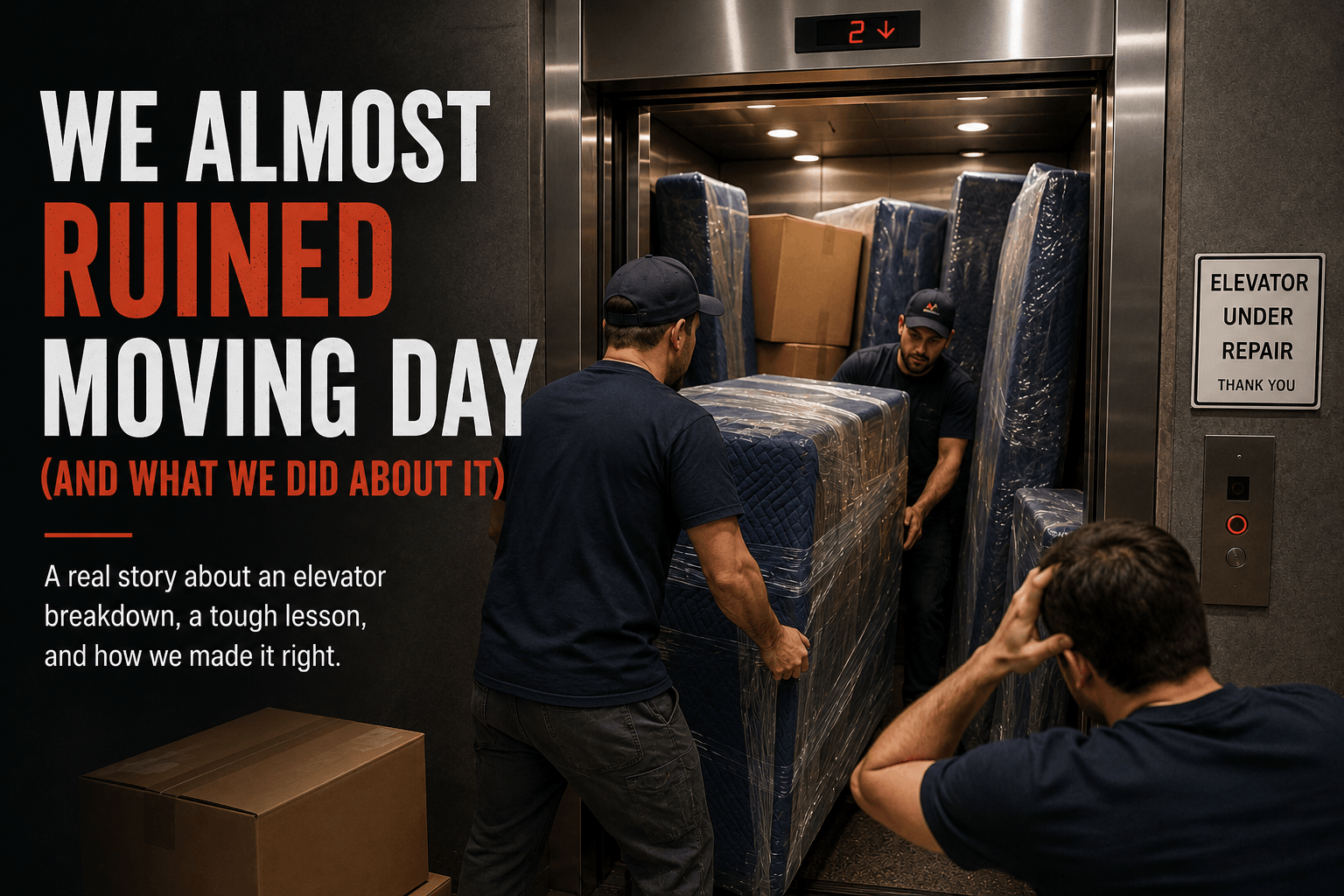
WE ALMOST RUINED MOVING DAY
And What We Did About It
Most moving companies only talk about the jobs that go perfectly. The pristine deliveries, the five-star reviews, the moves completed ahead of schedule. You have seen those posts.
This is not one of those posts.
What follows is a true account of one of the most stressful days in our company’s recent history — a move where our equipment failed, our crew was trapped, and our customer had every reason to walk away furious. We are telling this story because we think it says more about who we are than any highlight reel ever could.
Everything Was Going According to Plan
The move started like hundreds of others. Our customer was relocating from a high-rise apartment building — the kind of job our crew has handled dozens of times. We arrived early, completed a walkthrough of the unit, protected the floors with padded runners, wrapped the furniture, and began loading items into the building’s service elevator.
The crew was experienced. The equipment was in good condition. The customer was organized and ready. By every early indicator, this was going to be a clean, routine job.
The Moment We Knew Something Was Wrong
Two of our movers entered the freight elevator carrying several large furniture pieces — a sectional sofa, mattresses, moving straps, furniture pads, and several large boxed items. The doors closed. A loud metallic sound echoed through the elevator shaft.
Then silence.
The elevator stopped moving between floors.
Trapped Between Floors
Inside the car were two of our people, barely enough room to stand, and an entire load of furniture. Temperatures in the enclosed space rose quickly. Everyone outside — the rest of our crew, the customer, the building staff who happened to be nearby — began to worry.
This was not a minor inconvenience. This was an emergency.
Our First Priority Was Safety — Not the Schedule
We immediately contacted building management and the elevator maintenance service on record for the property. While we waited, we maintained constant voice communication with the trapped movers through the elevator door, providing updates and keeping them calm.
The move, the timeline, the customer’s schedule — none of that mattered until our people were safe. That was the only priority.
The Long Wait
What initially seemed like it might be resolved in minutes stretched into nearly an hour. The customer became anxious. Other logistics began to shift. The pressure outside the elevator was building even as the physical pressure inside it remained unchanged.
In situations like this, a company’s instinct is often to go quiet — to avoid the customer until there is good news to deliver. We did the opposite.
Taking Responsibility Means Staying in the Room
We kept the customer informed at every stage. Not with vague reassurances, but with real updates: what we knew, what we were doing about it, and what we did not yet know. We did not disappear into problem-solving mode and resurface only when the situation improved.
Transparency became our strategy — not because it was easy, but because we believe customers deserve honesty, especially when things go wrong.
Finally, The Elevator Opens
Elevator technicians arrived and eventually restored operation to the car. When the doors opened, our movers stepped out exhausted, relieved, and ready to get back to work.
Every piece of furniture was undamaged. The equipment had failed. Our people had not.
We Were Still Not Finished
The move had been delayed significantly. Rather than rush to complete the job and cut corners to make up time, we adjusted our approach:
We brought in additional staffing to accelerate the remaining work without compromising care.
We extended our availability to ensure the job was finished properly, regardless of how long it took.
We completed the move to the same standard we would have applied if the elevator had never failed.
A delay caused by equipment failure outside our control is not a reason to deliver substandard work. It never is.
What We Changed Afterwards
When a situation like this occurs, the question a serious company asks is not just “How do we recover?” but “What do we change so this is handled better next time?”
Building Coordination Protocols
We improved our pre-move process for high-rise buildings, including deeper verification of elevator condition, building maintenance contact information, and backup access plans before any job begins.
Emergency Communication
We strengthened internal communication protocols for situations where crew members are unreachable or in distress, including clearer escalation paths and faster response triggers.
Contingency Planning
We created specific contingency frameworks for elevator-related delays at properties where freight elevator access is the only viable loading option — including pre-identified stairwell alternatives and time buffers built into estimates.
What the Customer Said
That is not the review we hoped to earn that day. But it is the one we needed to earn.
The Truth About Moving — And About Any Service Business
Unexpected problems happen in every industry. Equipment fails. Buildings create obstacles. Schedules fall apart for reasons no one could have predicted. The companies that acknowledge this honestly are not admitting weakness — they are demonstrating maturity.
What separates trustworthy companies from unreliable ones is not whether problems occur. It is what happens in the moments after they do.
The elevator incident is not a story we lead with in sales conversations. But it is one we are proud to tell. Because the way our team responded that day — patient, communicative, transparent, and committed to finishing the job correctly — is the most accurate description of who we are that we can offer.
Anybody can look good when everything goes right.
We would rather show you what we look like when it doesn’t.
Frequently Asked Questions
What happens if there is a delay on my moving day that is outside your control?
We will inform you immediately, explain what is happening, and outline the options available to you. You will never be left waiting without communication. If the delay is significant, we adjust staffing and scheduling to complete your move properly — not just quickly.
What if something is damaged during my move?
We carry full liability coverage and operate a written claims process. If any item in our care is damaged, you submit a claim and we respond with a resolution within 30 days. Our license number and insurance documentation are available on request before you sign anything.
How do you handle buildings with restricted elevator access?
Our pre-move coordination process includes verification of elevator availability, maintenance contact information, and backup access options. For high-rise properties with single-point elevator access, we build contingency time into the job estimate and have protocols in place if that access is disrupted.
What does transparency look like in practice?
It means you know what is in your estimate and why. It means you are told about potential complications before moving day, not after. And it means that when something unexpected happens — as it occasionally will in any physical service — you hear about it from us immediately, with a clear explanation of what we are doing to address it.


