

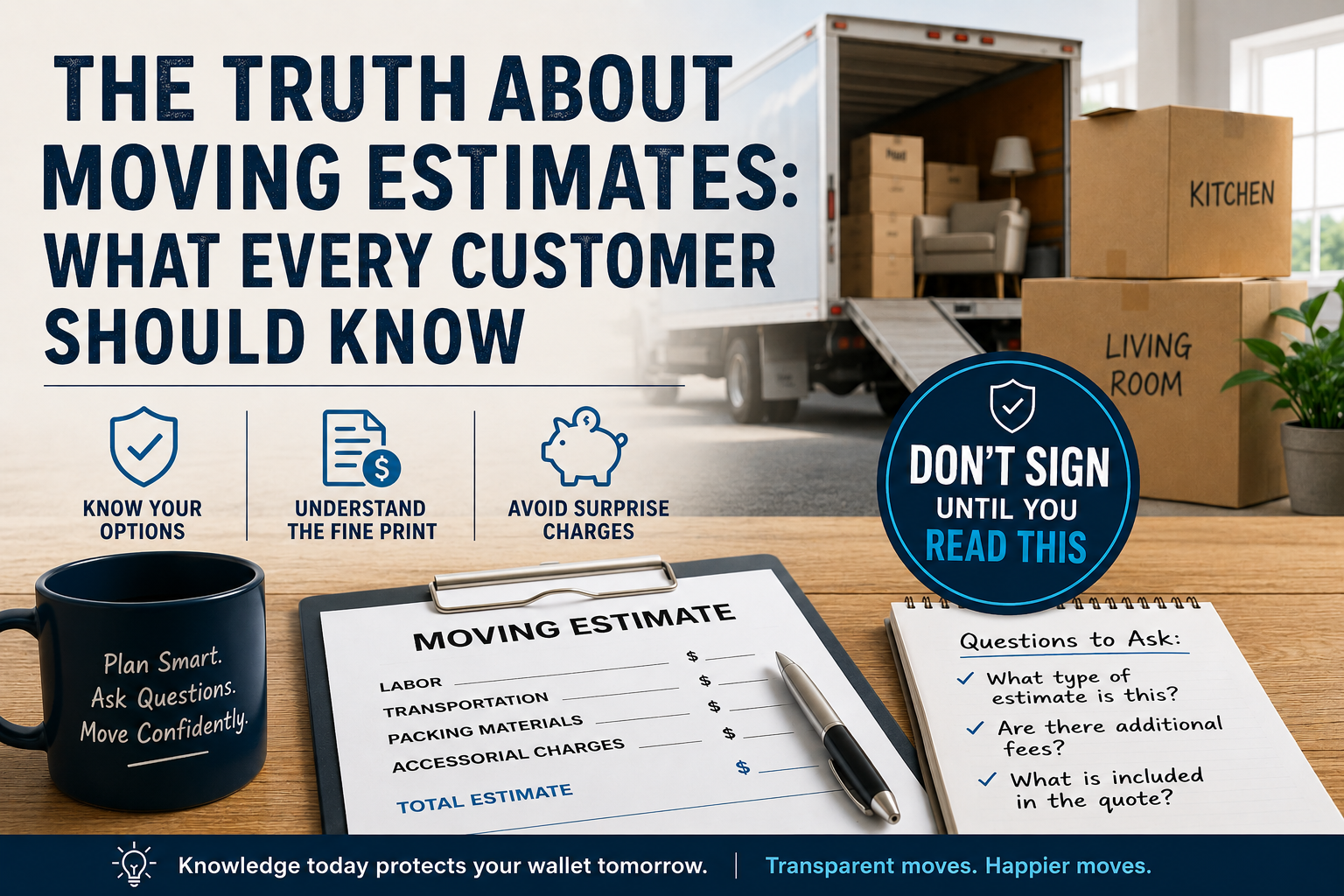
THE HONEST CONVERSATION ABOUT
Moving Estimates That Nobody in the Industry Wants to Have
You found a moving company. You got a quote. It looked reasonable — maybe even great. Then moving day arrived, and the final bill was a different number entirely. Sound familiar?
You are not alone, and you are not foolish. The moving estimate system is genuinely confusing, and parts of it are designed to be. This post is going to explain exactly how it works — the terminology, the contract language, the pricing structures, and the questions that separate honest movers from ones playing games with your budget.
At the end, we will also walk you through exactly how we build our own estimates — line by line, no surprises — so you can see the difference in real time.
First: The Three Types of Moving Estimates (And What They Actually Mean for Your Bill)
Most people assume a quote is a quote. It is not. There are three legally distinct estimate types used in the moving industry, and choosing the wrong one — or not knowing which one you signed — can cost you hundreds or thousands of dollars.
Binding Estimates
A binding estimate is a contract. The price you are quoted is the price you pay, period — regardless of how long the job takes, how heavy your furniture is, or how many stairs the crew has to navigate. The moving company is taking on the risk.
The upside: zero surprises. The downside: binding estimates are often priced conservatively on the high end to protect the company. You may pay a bit more than the job actually warranted.
Non-Binding Estimates
A non-binding estimate is closer to an educated guess than a contract. The company gives you a number based on an assessment of your move, but the final price is calculated after the fact based on actual weight, time, or distance traveled.
Federal regulations for interstate moves cap how much a mover can charge above a non-binding estimate — typically no more than 110% of the original quote. But for local moves, many states have no such protection. You could receive a final bill that is significantly higher than what you expected with little legal recourse.
Not-to-Exceed Estimates
A not-to-exceed estimate (sometimes called a "guaranteed not-to-exceed" or "price protection") combines elements of both. The quoted price is a ceiling — you will never pay more. But if the job comes in under that ceiling, you pay the lower amount.
This structure tends to be the most consumer-friendly of the three. It offers price protection while giving you the benefit of any efficiency the crew achieves.
The Contract Language That Allows Prices to Change
Even with a binding or not-to-exceed estimate, there are clauses buried in moving contracts that allow companies to revise the price after you have signed. Knowing what to look for before you sign is the difference between protection and exposure.
Watch for language around these five areas:
• Accessorial charges: These are fees for services not included in the base quote — things like long carry (if the truck cannot park close to your door), elevator use, shuttle service, or stair carry. These can be written into a contract in a way that gives the company broad discretion to add them on the day of the move.
• Weight adjustment clauses: On weight-based pricing, if the actual weight of your shipment exceeds the estimate, your bill increases. The question is whether the company weighed accurately in the first place.
• Packing material fees: If the company provides any packing — even wrapping a few fragile items on the fly — you may be billed per box, per roll of paper, or per pad at rates far above retail.
• Delivery window clauses: For long-distance moves, a broad delivery window that the company misses can trigger storage fees you did not anticipate.
• "Additional services" authorization: Vague language authorizing the crew to make judgment calls about necessary services — and bill for them afterward — without your explicit approval on the day.
Read every line before you sign. Ask the company to explain any clause that gives them pricing discretion after the contract is executed. If they cannot explain it clearly, that is your answer.
Weight-Based vs. Hourly Pricing: Which Is Better for Your Move?
Local moves are typically priced by the hour. Long-distance moves are typically priced by weight and distance. Understanding which structure applies to your move — and what affects your bill — lets you plan better and compare quotes accurately.
Hourly Pricing (Common for Local Moves)
You pay for the number of movers and hours worked, plus truck fees and any add-ons. Efficient crews save you money. Disorganized or slow crews cost you more. Variables that affect your hourly total include:
• How well-packed and organized your home is before the crew arrives
• Distance between your old and new home
• Parking access at both locations
• The number of large, heavy, or awkward items (pianos, safes, treadmills)
• Whether stairs, elevators, or long hallways are involved
Weight-Based Pricing (Common for Long-Distance Moves)
The truck is weighed before and after loading your belongings, and the difference is your shipment weight. That weight, combined with distance, determines your base cost. Variables that affect your weight-based total include:
• The actual weight of your furniture and boxes (which companies estimate, not always accurately)
• Items you decide to add on moving day that were not part of the original estimate
• How well the original estimator assessed your home's contents
Questions That Reveal Whether You Are Getting a Real Estimate
There is a meaningful difference between a company giving you a realistic estimate and a company giving you a low number designed to win your business (and adjust the bill later). These questions will tell you which one you are dealing with:
• "Is this a binding, non-binding, or not-to-exceed estimate — and can you show me that in writing?" Any legitimate company will answer this immediately and clearly.
• "What is your process for weighing or timing the job, and how do disputes get resolved?" A good answer involves a clear process. Vague answers are a red flag.
• "What accessorial charges could be added on moving day, and what triggers each one?" You want a specific list, not a general "it depends."
• "Can you walk me through the items that are and are not included in this quote?" Legitimate movers will do this without hesitation.
• "Are packing materials included, and if the crew uses any supplies, what is the per-unit cost?" Know the cost before the tape comes out.
• "What is your process if something is damaged?" This reveals both competence and good faith. Confident companies have a clear answer.
• "Can I see your license number and proof of insurance?" In most states, movers are required to be licensed. Any hesitation here is disqualifying.
What Rogue Movers Look Like: Red Flags Before You Sign
Not every moving company that gives you a bad experience is malicious. But there is a specific category of bad actor — often called a rogue mover — that preys on consumers in predictable ways. Here is what to watch for:
• A quote given without seeing your belongings. Any estimate provided over the phone without a home walkthrough, video survey, or detailed inventory form should be treated as approximate at best and a lowball tactic at worst.
• Unusually low initial prices. Predatory companies win business by underbidding, then add charges after your belongings are on the truck — when you have no leverage.
• Large deposits required upfront. Legitimate movers rarely require significant deposits before the move is complete. A large required deposit, especially before any work is done, is a warning sign.
• No physical address or professional branding. A truck, a phone number, and a generic name is not a company with accountability.
• No written contract. If a company wants to do business on a handshake, walk away.
• Rented trucks with no company markings. Professional movers operate branded equipment. Mystery trucks are a common indicator of unlicensed operations.
• Refusal to provide license and insurance documentation. In most states, moving companies are legally required to be licensed. Ask. If they deflect, disengage.
A company willing to hold your belongings hostage pending additional payment is the worst-case scenario — and it happens far more often than it should. Every precaution above reduces the chance of finding yourself in that situation.
How to Compare Quotes When Companies Use Different Pricing Structures
Comparing quotes from companies using different estimate types and pricing structures is genuinely difficult. Here is a framework that makes it manageable:
Step 1: Standardize the scope
Make sure every company is quoting the same job. Same inventory, same services (packing, assembly, disassembly), same access conditions. Apples-to-apples comparison only works if the scope is identical.
Step 2: Identify what is and is not included
List every potential cost that could be added to each quote: packing materials, stair fees, long carry, fuel surcharges. Calculate a realistic total-cost scenario for each company, not just the headline number.
Step 3: Evaluate estimate type risk
A binding estimate at $1,800 may be a better value than a non-binding estimate at $1,500 if the non-binding estimate has significant upward risk. Factor in the ceiling, not just the floor.
Step 4: Factor in credibility
Licensing, insurance, reviews, years in business, responsiveness to your questions — these things matter. A slightly higher price from a vetted, responsive, licensed company is almost always the better investment than a lower price from a company that struggles to answer basic questions.
Your Rights If the Final Bill Is Significantly Higher Than the Estimate
If you find yourself facing a bill that is dramatically higher than what you were quoted, you are not without options. The specifics depend on whether your move is interstate or local.
For Interstate Moves
Federal regulations under the Federal Motor Carrier Safety Administration (FMCSA) provide specific consumer protections. Key rights include:
• For non-binding estimates, movers cannot require you to pay more than 110% of the original estimate at delivery. Any amount above that must be billed afterward with a 30-day payment window.
• You have the right to be present when your shipment is weighed and to request a reweigh before paying.
• The mover must deliver your goods upon payment of the 110% amount, even if a dispute is ongoing.
• You can file a claim through the FMCSA for violations of federal moving regulations.
For Local Moves
Protections vary by state. In general:
• Review your state's consumer protection laws — many states have specific moving regulations administered by a public utilities commission or department of transportation.
• If the company's conduct appears fraudulent, file a complaint with your state's attorney general's office.
• Document everything: your original estimate, any communications, the final bill, and any discrepancy.
• Disputes that cannot be resolved directly may be taken to small claims court.
• Industry organizations such as the American Moving and Storage Association (AMSA) operate arbitration programs that some member companies are required to use.
The Other Side of the Story: Why Estimates Sometimes Go Over
Most conversations about moving estimates focus entirely on what companies do wrong. That’s fair — bad actors exist and deserve scrutiny. But there’s another side to this that rarely gets discussed honestly: a significant number of estimates go over budget not because the mover was deceptive, but because the information the estimate was built on was incomplete from the start.
A moving company can only price what it knows about. When a customer describes their home as “a two-bedroom, not a lot of stuff” — and doesn’t mention the storage unit, the packed garage, the spare room being used as overflow, or the boxes that haven’t been sorted yet — the estimate reflects that description. Not the reality. By moving day, what felt like a small move has become a full-day job, and the original number no longer fits.
This isn’t about blame. Most customers aren’t deliberately misleading anyone — they genuinely underestimate what they own. Moving has a way of surfacing just how much has accumulated over the years. The point is simply this: an estimate is only as accurate as the inventory it’s built on. Incomplete information in, inaccurate number out.
Timing compounds the problem. When a customer calls close to their move date, there often isn’t enough lead time to do a proper assessment. A quote put together in a ten-minute phone call will almost always be less accurate than one built from a real walkthrough — and that gap between what was described and what actually needs to move is where most cost overruns originate.
The Fix: A Free On-Site Estimate — In Person or Virtually
The most effective solution to inaccurate estimates — from both sides of the equation — is an on-site quote. Some moving companies, including ours, offer this at no charge. It removes the guesswork entirely.
In-person walkthrough: A representative visits your home, walks every room, checks the garage, storage spaces, and any overflow areas, and documents everything on-site. Nothing gets missed, nothing gets assumed. This is the most accurate method available and the one we recommend for larger or more complex moves.
Virtual survey: You walk through your home on a video call while a moving specialist guides you room by room, noting items and flagging anything that could affect cost. It’s flexible, easy to schedule, and gets close to the accuracy of an in-person visit — making it ideal for busy schedules or customers planning a move from out of state.
Both options are significantly more accurate than a phone estimate. Both are free. And both protect you from the single biggest source of moving day surprises: a number that was never built on the full picture.
How We Build Our Estimates — And Why We Do It Differently
Everything above describes how the moving industry works in general. Here is how we work in specific.
Our estimates begin with a walkthrough — either in-person or via video survey. We do not quote jobs we have not seen. The reason is simple: an estimate built on a real inventory of your belongings is an honest number. An estimate built on a conversation is a guess that benefits us if we're wrong, not you.
What Is Always Included in Our Base Quote
• All labor — crew and time based on a realistic assessment of your specific job
• Fuel and truck fees — no surprise surcharges at delivery
• Basic furniture protection (pads and wrap for standard furniture)
• Loading and unloading, including standard stair carries (up to two flights)
What Can Change — And Why We Tell You in Advance
We believe in transparency about uncertainty, not surprises. The following are situations where additional costs can legitimately arise, and we address them in every estimate conversation:
• Long carry: If our truck cannot legally or physically park within a standard distance from your door, a long carry fee applies. We note this upfront for any address where access is a known issue.
• Third-floor or above: Stair carries beyond two flights, or elevator use in buildings with limited access, adds time. We account for this in the estimate.
• Piano, safe, or specialty items: These require specific equipment and expertise. We quote them as line items, not surprises.
• Packing services: If you want us to pack any portion of your home, we quote that separately with per-box rates disclosed in advance.
• Weight variance (long-distance only): For long-distance moves, we offer a not-to-exceed structure wherever possible. You know the ceiling before you sign.
Your Recourse If Something Goes Wrong
We have a written claims process. If any item is damaged in our care, you submit a claim and we respond within 30 days with a resolution. We carry full liability coverage, and our license number is publicly available.
We are not going to tell you we are perfect — every moving company has a bad day occasionally. What we can tell you is that our process, our transparency, and our accountability are consistent. That is the honest version of "we are the best movers."
The Bottom Line
Moving estimates are complicated by design and by circumstance. Understanding the vocabulary, the contract terms, the pricing structures, and the questions to ask does not make a move risk-free — but it changes the power dynamic. You walk into every conversation as an informed consumer, not someone hoping for the best.
Ask hard questions. Demand written answers. Compare total realistic cost, not just headline numbers. And if a company struggles to tell you clearly what you are signing and why the price is what it is — keep looking.
Transparent movers exist. You just need to know how to find them.
Frequently Asked Questions
What is the most consumer-friendly type of moving estimate?
A not-to-exceed estimate offers the strongest protection — it caps your cost while allowing you to benefit if the job comes in under budget. For local hourly moves, a clear written scope of what is included (with accessorial charges disclosed in advance) offers comparable protection.
Can a moving company legally hold my belongings until I pay an inflated bill?
For interstate moves, federal law requires movers to release your goods upon payment of 110% of a non-binding estimate — the remainder can be billed afterward. However, enforcement requires you to know your rights and, if necessary, to file a complaint. For local moves, the rules vary by state. The best protection is a binding or not-to-exceed estimate from a licensed, insured company before anything goes on the truck.
How can I verify that a moving company is licensed?
For interstate movers, you can search the FMCSA database using the company's USDOT number. For local movers, check your state's regulatory body — this is often the state department of transportation or public utilities commission. Any licensed mover should provide their license number willingly.
Is a verbal quote legally enforceable?
In most cases, no — or at least not easily. A written estimate with a clear description of services and pricing is always preferable. If a company only provides verbal quotes, that is itself a red flag.
What should I do if the final bill is much higher than quoted?
Document everything in writing. For interstate moves, pay the 110% amount to secure release of your goods, then dispute the remainder through the FMCSA or arbitration. For local moves, file a complaint with your state attorney general or consumer protection office and consider small claims court if the amount warrants it.


